

Founding Attorney
Dolly Parton’s Estate Plan: What It Teaches New Yorkers Without Kids
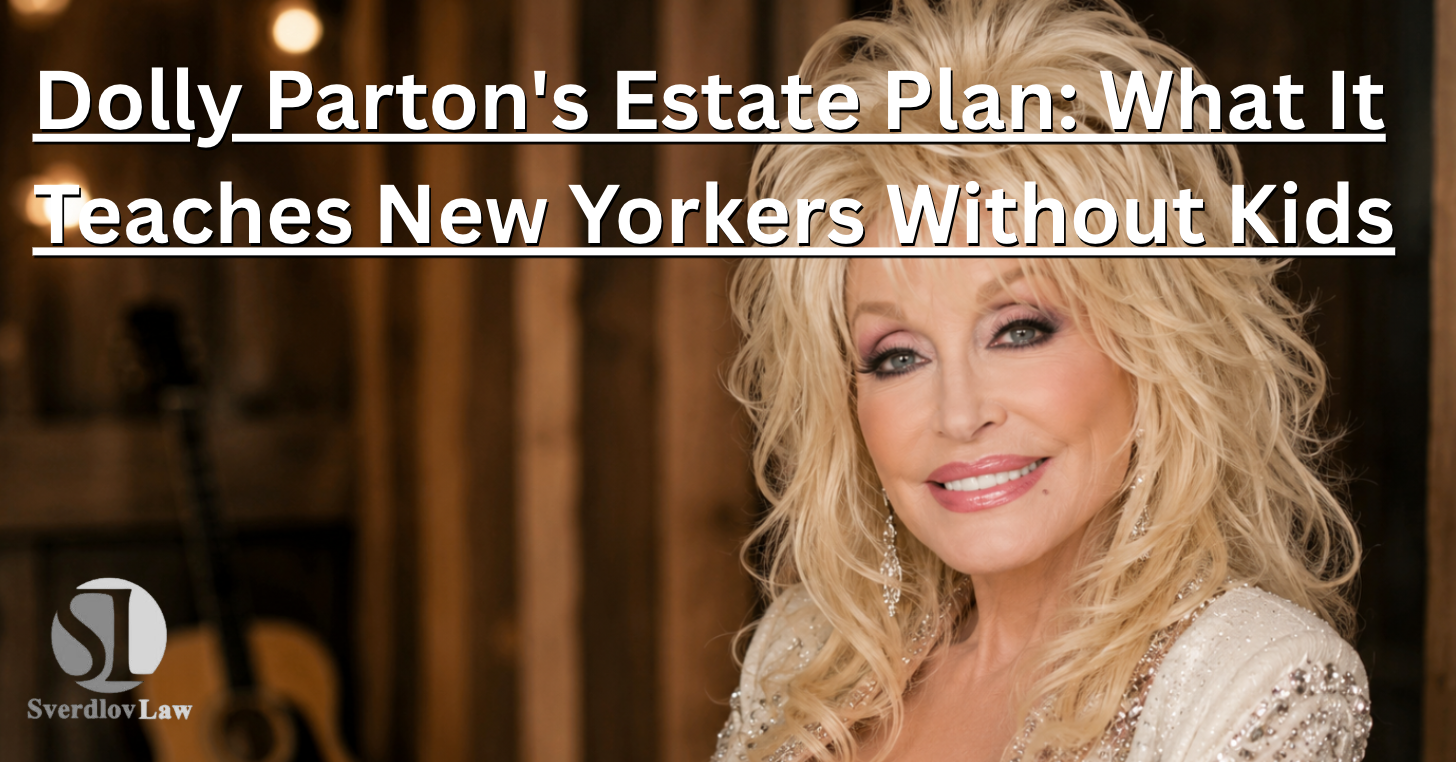
Dolly Parton’s fortune could be worth as much as $650 million, and she has no children. Her husband of nearly sixty years, Carl Dean, died in 2025. For months, entertainment outlets have tried to answer one question: who inherits it all?
The honest answer, from every reporter who has tried to find out, is that nobody really knows. That is not an accident. It is what a well built estate plan looks like from the outside.
Why “No Kids, No Spouse” Is a Bigger Problem Than People Think
Most people picture estate planning as a spouse and children waiting to inherit. That is not Dolly Parton’s situation, and it is not the situation for a lot of New Yorkers either: people who never married, never had children, outlived a spouse, or are simply estranged from the family they do have.
If you die in New York without a will or trust, state law decides who gets your property, and it does not ask what you would have wanted. Under New York’s intestacy statute (EPTL 4-1.1), the estate passes in a strict order:
● Spouse and children first
● Then parents
● Then siblings
● Then nieces and nephews
● Then more distant relatives, working outward through the family tree
If no relative in that chain can be found, the estate can escheat to New York State. A distant cousin you have never met can inherit ahead of the friend who checked in on you every week, the goddaughter you helped raise, or the charity you cared about for decades. That gap only gets fixed with a signed document naming the people you actually choose.
The Real Lesson in “We May Never Know”
Reporters keep noting that Dolly Parton’s estate plan is not public, and that is the most useful detail in the whole story. A will has to go through Surrogate’s Court in New York, and once the executor files it, the will becomes a public record that anyone can request. A trust generally does not. Assets held in a properly funded trust pass to beneficiaries privately, without a probate filing and without the court supervision a will requires.
For someone with a music catalog, a theme park stake, and a business empire, that privacy is not vanity. It is protection, for the business and for the people connected to it. For an ordinary family, the same logic applies at a smaller scale: a trust can keep your finances out of public court records, avoid probate delays that can stretch for months, and let assets reach beneficiaries faster and on your terms, including staggered distributions for a young adult or a beneficiary who needs extra structure.
Small Things Cause the Biggest Family Fights
Reports on Carl Dean’s estate describe him leaving handwritten instructions about which family members should receive specific personal items. That detail matters more than it sounds. In our experience, the fights that tear families apart are rarely about the investment accounts. They are about the wedding ring, the guitar, the letters, the things that cannot be divided evenly and were never really about money.
A basic will often says almost nothing about personal property. A complete plan should include a specific, signed list of who gets which sentimental items, kept alongside your will or trust. It costs almost nothing to write and prevents arguments that outlast the estate itself.
Legacy Planning Isn’t Only for Celebrities
Dolly Parton’s Imagination Library has distributed books to children for decades, and Dollywood’s operations support thousands of jobs in Tennessee. Neither of those continues by accident after a founder’s death. Trusts and clear succession planning are what let a mission, or a livelihood, keep running instead of stalling out in probate. You do not need a theme park for this to apply.
A family business, a jointly owned brownstone in Brooklyn, or a co-op that a family has owned for two generations can all end up frozen or forced into a sale if the owners do not spell out the ownership plan ahead of time. The tools are the same ones Sverdlov Law uses every day: wills, revocable and irrevocable trusts, Powers of Attorney, Health Care Proxies, and proper trust funding, so the plan on paper actually controls the assets when it matters.
What This Means for You
You do not need $650 million or a household name for any of this to apply. You need a plan that reflects your actual family, not a default statute written for a family you may not have. The rules on intestacy, probate, and trust privacy interact in ways that are easy to miss until it is too late to fix them. A short conversation with an estate planning attorney can catch those gaps well before your family has to sort them out in Surrogate’s Court.
What you can do now:
● Write down, and sign, who gets specific sentimental items. Do not leave it to memory.
● If you have no obvious heir, name one in writing. New York’s default rules will not know who mattered to you.
● Ask whether a revocable trust fits your situation better than a will alone, especially if privacy or a business is involved.
● Pair your plan with a Health Care Proxy and Power of Attorney, so incapacity is covered, not just death.
Sverdlov Law PLLC works with clients across Manhattan, Brooklyn, Queens, and the Bronx to build plans around real families and real relationships, not just tax codes. If something happened to you tomorrow, ask yourself plainly: would you be deciding who gets your things, or would the State of New York?
If you have questions about wills, trusts, intestacy, probate, or protecting your family’s future, contact Sverdlov Law, PLLC today. Because when it comes to what happens to your life’s work and the things you leave behind, you should be the one making the decisions—not New York’s default rules.
Click here to schedule a complimentary evaluation of your case.
Image Disclaimer: All images featured in this email are AI-generated for illustrative purposes and are not intended to represent actual photographs or events. The information provided in this blog post is for general informational purposes only and does not constitute legal advice. Every inheritance dispute case is unique and requires individual analysis. Please contact Sverdlov Law PLLC for a confidential consultation regarding your specific circumstances.