

Founding Attorney
Power of Attorney in New York: Why a Will Is Not Enough
“I have a will, so I am covered.” We hear this often, and it leaves a gap that costs families real money. A will does nothing while you are alive. If illness or a scam leaves you unable to manage your finances, your family may be locked out of your accounts at the worst possible moment.
Does a Will Protect You if You Lose Capacity?
No. A will takes effect only at death, and it controls only what you own at that point. It gives nobody authority to pay your bills, call your bank, or sell your apartment while you are living.
A power of attorney (POA) is the document that works during your lifetime. You, the principal, name a trusted person, your agent, to handle your finances. In New York, the rules are in the General Obligations Law, Article 5, Title 15 (sections 5-1501 through 5-1514). A New York POA is durable unless it says otherwise (section 5-1501A), so your agent’s authority continues if you lose capacity. Without one, your family may need a court to appoint a guardian. That takes time and legal fees, and a judge, not you, picks the guardian.
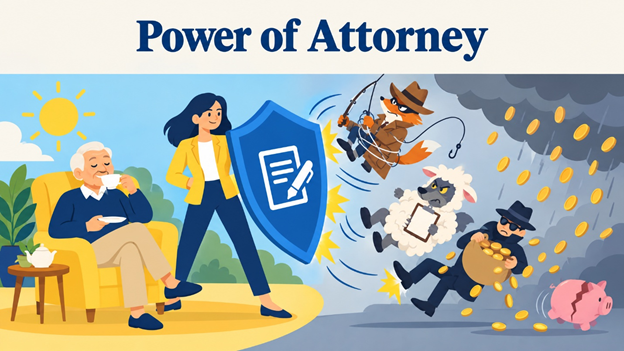
How a Power of Attorney Acts Like a Shield
A POA cannot stop a scammer from calling you. What it does is put someone you chose in a position to notice trouble and act on it. Three common threats show how.
- Phishing (the fox with the fishing rod). Fake emails and texts fish for passwords and account numbers. When your agent already knows your accounts and bills, an odd request is more likely to be questioned before anyone answers it.
- The fake helper (the wolf in sheep’s clothing). A caller posing as your bank, a government office, or a friendly contractor counts on pressure and secrecy. You can tell anyone who contacts you that money matters go through your agent, which gives you a reason to hang up.
- Theft (the masked thief). Without a POA, nobody has legal authority to review or protect your accounts once you lose capacity. With one, a person you picked already has that authority.
One Phone Call, Two Outcomes
Consider a 79-year-old widower in Queens with early memory loss. A caller claiming to be from his bank’s fraud department persuades him to wire $40,000 to a “safe account.”
Without a POA, his daughter in Brooklyn learns about it weeks later. The bank is unlikely to discuss his accounts with her, and she cannot step in without a guardianship case.
With a POA he signed years earlier, she can present it to the bank, protect what remains, and report the fraud. The POA cannot undo the wire, but it can stop a second one.
In New York, section 5-1504 gives a bank ten business days after receiving an original or attorney certified statutory short form POA to accept it, reject it in writing with reasons, or ask the agent for a signed affidavit. That rule is New York specific.
A POA Is Not a Perfect Shield
An agent holds real power, and a dishonest agent can misuse it. Under section 5-1505, your agent is a fiduciary who must act in your best interest, avoid conflicts of interest, keep your money separate from their own, and record every receipt and payment. An agent may not give your property to themselves unless the document specifically allows it.
The New York statutory form lets an agent make limited gifts of up to $5,000 a year. Larger gifts must be expressly granted in the Modifications section.
Choosing the agent matters more than any clause.
- Pick for honesty with money, not for birth order or convenience.
- Name a successor agent (section 5-1508) who serves if your first choice is unable or unwilling.
- Consider naming a monitor (section 5-1509), a person who can ask your agent for records.
- Tell your family who you chose and why.
What New York Requires for a Valid POA
These signing rules are New York specific (section 5-1501B).
- You must have capacity when you sign, so sign before you need it.
- You sign, initial, and date it, your signature is notarized, and two witnesses who are not named as agents or gift recipients watch you sign. The notary may serve as one witness.
- Your agent signs and has that signature notarized too. The POA ordinarily takes effect as to that agent on the date of the notarization.
- A POA ends at your death and does not cover health care. A Health Care Proxy handles medical decisions.
What This Means for You
Sverdlov Law’s mission is to preserve both family assets and family harmony. We help people plan for incapacity and death so their families avoid chaos later, and the POA is one piece of that. It handles money during your life, a Health Care Proxy handles medical decisions, and a Will or Trust, properly funded, handles what comes after.
The rules here interact in ways that are easy to miss, from gift limits to how several agents must act together. A brief conversation with an estate planning attorney can catch those gaps before they cost your family. We work with clients across Manhattan, Brooklyn, Queens, and the Bronx.
What You Can Do Now
- Check your documents. A will alone does not cover incapacity.
- Pick an agent and a successor, and ask each whether they are willing to serve.
- If you signed a POA years ago, have an attorney confirm it still fits your wishes.
- Schedule a consultation to put a POA, Health Care Proxy, and Will in place together.
If your bank called tomorrow about suspicious activity on your account, who in your life could legally step in and talk to them?
Contact Our Office – Sverdlov Law PLLC
Image Disclaimer: All images featured in this email are AI-generated for illustrative purposes and are not intended to represent actual photographs or events. The information provided in this blog post is for general informational purposes only and does not constitute legal advice. Every inheritance dispute case is unique and requires individual analysis. Please contact Sverdlov Law PLLC for a confidential consultation regarding your specific circumstances.